

From Singapore to New York, the hidden affordability story lies in spending power, not housing costs.
The conventional wisdom is simple: expensive cities have unaffordable housing. Yet our latest global affordability analysis[1] suggests the real divide is not simply between high- and low-rent cities, but between cities where incomes have kept pace with housing costs and those where they have not. The affordability matrix, which combines rent burdens and residual income, reveals a more nuanced picture of urban affordability.
Consider Singapore, Dubai, Abu Dhabi, Sydney and San Francisco. None are cheap places to live. Yet households retain substantial spending power after paying rent because strong labour markets and high incomes offset housing costs. Singapore leads the ranking, while Dubai and Abu Dhabi also score exceptionally well despite their global-city status.
As Martin Lippmann, Head of Real Estate Research Europe, observes: “The key question is no longer how much households pay in rent, but how much income they have left afterwards. High rents do not automatically make a city unaffordable if income growth is keeping pace.”
The contrast is evident in New York, Hong Kong, Beijing, Shanghai, Mumbai and Manila. These cities are engines of growth and opportunity, yet many households devote an exceptionally large share of their income to housing and are left with far less financial flexibility after paying rent. Economic dynamism has been strong, but earnings have struggled to keep pace with housing costs.
The implication is important. Housing affordability is not simply a rent problem. It is also an income problem and, in many cases, a supply problem. Cities such as Dallas, Austin, Helsinki, Kuala Lumpur and Dubai have accommodated growth through housing delivery, income growth, or both. Others have become victims of their own success, attracting people and capital faster than housing can be provided.
For investors and policymakers alike, the lesson is clear. The future winners will not necessarily be the cities with the lowest rents. They will be the cities that successfully balance growth, income creation and housing supply. Increasingly, housing affordability is becoming a measure of whether prosperity is being shared by the people who live there, rather than simply a measure of the cost of housing itself.
Affordability ratio & remaining disposable income
(Affordability ratio in %, residual spending power in USD, PPP)
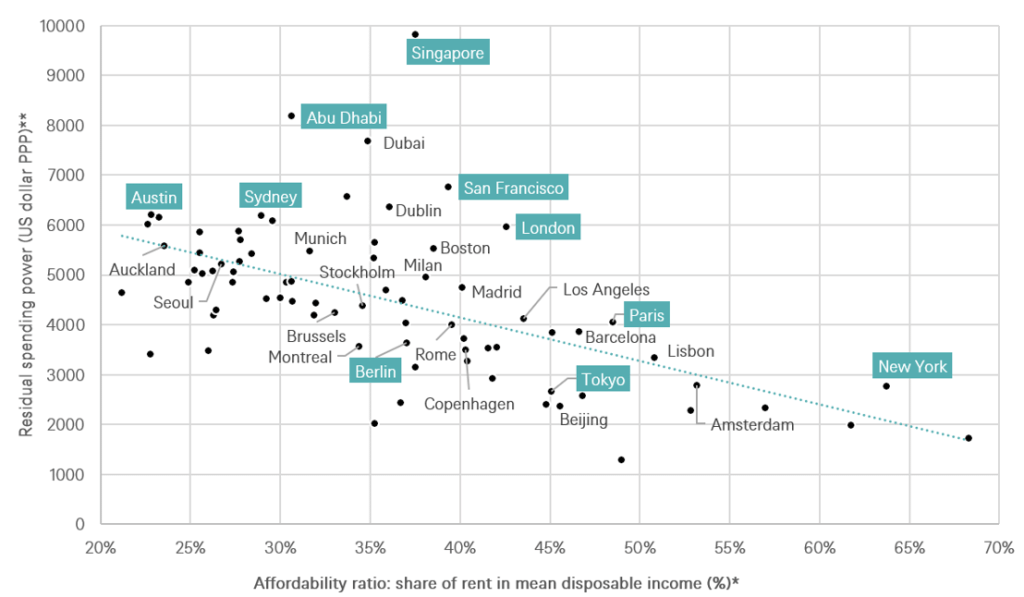
** Residual spending power is the total disposable income remaining after rent (US dollar PPP).
This information is subject to change at any time, based upon economic, market and other considerations and should not be construed as a recommendation. Past performance is not indicative of future returns. Forecasts are based on assumptions, estimates, opinions and hypothetical models that may prove to be incorrect. Alternative investments may be speculative and involve significant risks including illiquidity, heightened potential for loss and lack of transparency. Alternatives are not suitable for all clients.